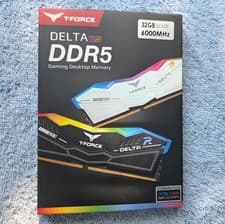
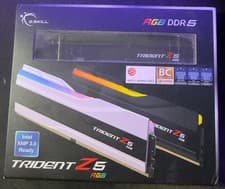
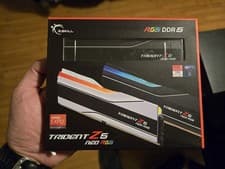
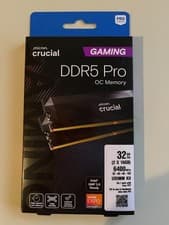
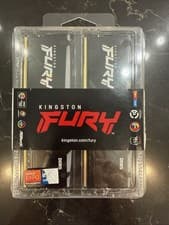
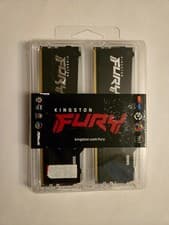
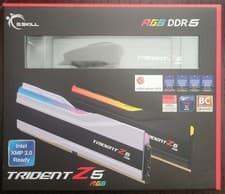
32GB is the mainstream baseline; 64GB for creators and heavy multitasking.
During the 2025–26 surge, prioritize kits near their lowest tracked price.
On this page (8 sections)
Intel Core Ultra 200S "Arrow Lake" on LGA1851 runs DDR5-6400 natively, and the Arrow Lake Refresh raises native support to DDR5-7200 with CUDIMM modules (whose onboard clock driver enables stable 8000+ MT/s). These live picks balance speed, capacity, and current pricing for an Arrow Lake build.
What Arrow Lake actually wants from memory
Core Ultra 200S is the first mainstream desktop platform to make DDR5-6400 the native, in-spec memory speed, with no overclock profile required. Its disaggregated tile design also moved the memory controller off the compute die, which raised memory latency compared with Intel's older monolithic desktop parts. That cuts both ways: Arrow Lake benefits more from fast, well-timed memory than its predecessors did, but you capture most of that benefit at the native 6400 without paying for exotic bins.
CUDIMMs, explained in one minute
A CUDIMM is a standard DDR5 module plus a clock driver (CKD), a small chip that regenerates the memory clock on the module itself instead of trusting whatever signal arrives from the CPU across the motherboard. Clean clocking is the limiting factor at very high transfer rates, so CUDIMMs are what make 8000+ MT/s stable on Arrow Lake, and the Arrow Lake Refresh raises officially supported speed to DDR5-7200 with them.
Two buying notes. First, current AMD boards typically run CUDIMMs in bypass mode, where the clock driver contributes nothing; this is an Intel-side purchase. Second, at 6400 a conventional UDIMM is all you need, so pay the CUDIMM premium only when you are genuinely chasing 7200 and beyond.
XMP, capacity, and the sane configuration
Rated speeds beyond JEDEC ship as Intel XMP 3.0 profiles: one BIOS toggle, the same idea as AMD's EXPO. Kits validated with EXPO usually carry XMP too, but check the spec sheet rather than assuming. Capacity follows the platform norm: 32GB in 2×16GB is the mainstream baseline for gaming and productivity, 64GB in 2×32GB for creators. Keep it to two DIMMs: populating all four slots drops supported speeds on LGA1851 just as it does everywhere else in the DDR5 era.
How these picks are chosen
The list below filters to DDR5 kits of 32GB or more at 6000MT/s and up from brands we track (the range an Arrow Lake build actually shops in) and orders them by how near each kit's live price is to its own lowest tracked price, followed by kits whose shipping-included price is too new to have a range, cheapest per GB first. Prices are scraped from eBay and Newegg several times a day; an offer unverified for a week can no longer win best-price selection, and nothing older than two weeks is displayed as current. The order is set by price history alone: commission has no vote, as our affiliate disclosure spells out.
Some links below are affiliate links: RamRadar may earn a commission if you buy through them, at no extra cost to you. How we make money
Current top picks
Live prices from RamRadar so this page behaves like a decision page, not a static article.
RamRadar re-ranks these picks using live pricing and current fit signals instead of leaving a static affiliate list untouched for months.
Updated from live product data on Nov 8, 2026
Market-aware ranking
We favor kits trading well versus their all-time low so this page points to buyable options, not stale listicles.
Fit before hype
Capacity, platform fit, and real-world value matter more than headline specs that rarely change your outcome.
Trust-aware offers
We bias toward known brands and cleaner retailer signals so weak or misleading listings do not dominate the recommendations.
Why these picks made the cut
Live pricing
Every recommendation is pulled from current RamRadar pricing, so this page reacts to the market instead of freezing in time.
Trust-first filtering
We prioritize known brands and cleaner live pricing signals so obvious junk and misleading offers do not dominate the shortlist.
Buy-now logic
Near-ATL positioning and current value matter more than vanity specs if the goal is to buy well today.
FAQ
What RAM speed is best for Arrow Lake?+–
DDR5-6400 runs natively; with CUDIMM kits, Arrow Lake (and especially the Refresh) supports DDR5-7200 and higher. For most builds, a quality 6400 kit is the value pick.
What is a CUDIMM?+–
A CUDIMM adds an onboard clock driver (CKD) that re-times the memory clock for stability at very high speeds (8000+ MT/s). Intel Arrow Lake is the mainstream platform that benefits most from it.
Will a CUDIMM kit work on an AMD AM5 board?+–
Generally yes, but in bypass mode: the clock driver is disabled and the module behaves like a standard UDIMM. Buy CUDIMMs for Arrow Lake, where the clock driver actually does its job.
Who should skip this guide
AM5 builders: your sweet spot is DDR5-6000 CL30 EXPO and your divider math is different; the 9800X3D guide covers it. Owners of 12th–14th-gen Intel (LGA1700): your boards top out lower and may even be DDR4; buy for the board you have, not this one. And nobody needs an 8000MT/s CUDIMM kit for a gaming build; that money belongs in the GPU column.