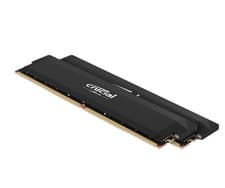
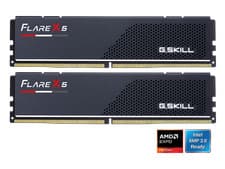
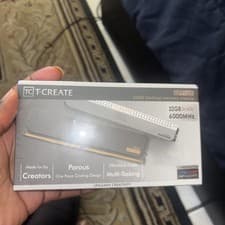
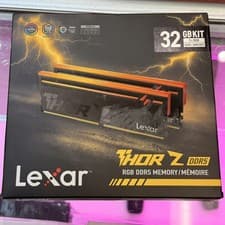
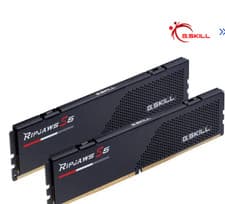
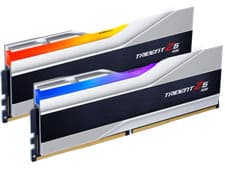
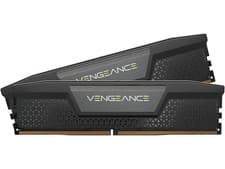
Favor low-latency EXPO-friendly kits over headline speed alone.
If a kit is far above its lowest tracked price, wait unless you need the upgrade immediately.
On this page (8 sections)
For a 9800X3D build, you want stable DDR5 with strong gaming latency without overpaying for speed you will never feel. Thanks to its 3D V-Cache, this CPU is famously insensitive to memory speed, which makes the buying decision about price discipline, not spec-chasing. These live picks prioritize trusted brands, current pricing, and the AM5 sweet spot.
The 9800X3D barely cares about RAM speed: that is the point
The 9800X3D's 3D V-Cache is a large slab of extra L3 stacked onto the die, and it exists to keep game data on-chip instead of in RAM. The practical consequence: memory speed matters less on this CPU than on almost any other desktop part. Reviews consistently show only a few percent separating sensible DDR5 from exotic kits in games, because the cache absorbs most of the memory traffic that fast RAM would otherwise accelerate.
That is a gift to your budget in an expensive memory market. The winning move is a competent kit at the platform sweet spot bought near its historical low, not a halo kit at any price.
DDR5-6000 CL30 EXPO: the AM5 sweet spot, explained
AMD's memory controller runs 1:1 with the memory clock (UCLK = MEMCLK) up to around DDR5-6000. Past that, the controller usually drops to a 2:1 divider that adds latency, so a 6400 or 7200 kit can actually bench worse in games than a well-timed 6000 kit on this platform. 6000 CL30 works out to a true first-word latency of 10ns (2000 × 30 ÷ 6000), and that is the practical target.
EXPO is AMD's answer to Intel's XMP: the kit boots at a conservative JEDEC speed and carries its rated 6000 CL30 profile as a one-toggle BIOS setting, validated for AMD boards. Most XMP kits also run fine on AM5, but at equal price take the EXPO-badged kit: it is the profile actually tested for your platform.
Capacity: 32GB, in two sticks
32GB (2×16GB) is the correct default for a gaming build in 2026: modern titles plus a browser and launchers have made 16GB genuinely tight, and 64GB only earns its cost if you stream, edit, or run heavy productivity on the same box. Stick to two modules: AM5 boards drop supported memory speeds when all four slots are loaded, so 2×16GB beats 4×8GB every time.
How these picks are ranked
Every pick below is a 32–64GB DDR5 kit at 5600MT/s or faster from a brand we track, ranked by how close its live price sits to its own lowest tracked price, followed by kits whose shipping-included price is too new to have a range, cheapest per GB first. Pricing comes from eBay and Newegg price checks run several times a day; offers that have not been re-checked within a week lose best-price selection, and nothing older than two weeks displays as current. Commission never moves a ranking: if the cheapest fresh offer is at a retailer that pays us nothing, that is the link you get (see our affiliate disclosure).
Some links below are affiliate links: RamRadar may earn a commission if you buy through them, at no extra cost to you. How we make money
Current top picks
Live prices from RamRadar so this page behaves like a decision page, not a static article.
RamRadar re-ranks these picks using live pricing and current fit signals instead of leaving a static affiliate list untouched for months.
Updated from live product data on Nov 20, 2026
Market-aware ranking
We favor kits trading well versus their all-time low so this page points to buyable options, not stale listicles.
Fit before hype
Capacity, platform fit, and real-world value matter more than headline specs that rarely change your outcome.
Trust-aware offers
We bias toward known brands and cleaner retailer signals so weak or misleading listings do not dominate the recommendations.
Why these picks made the cut
Live pricing
Every recommendation is pulled from current RamRadar pricing, so this page reacts to the market instead of freezing in time.
Trust-first filtering
We prioritize known brands and cleaner live pricing signals so obvious junk and misleading offers do not dominate the shortlist.
Buy-now logic
Near-ATL positioning and current value matter more than vanity specs if the goal is to buy well today.
FAQ
Is 6000MHz still the sweet spot for Ryzen gaming builds?+–
Usually yes. For most AM5 gaming systems, 6000MHz-class kits remain the practical balance of price, stability, and latency.
Should you pay extra for RGB on a 9800X3D build?+–
Only if aesthetics matter. Price and latency matter more than lighting if you are trying to maximize value.
Does the 9800X3D benefit from DDR5-7200 or 8000 kits?+–
Barely. Above roughly 6000MT/s, AM5 usually drops the memory controller to a 2:1 divider, and the X3D cache mutes what little gain would remain. Spend the difference on the GPU.
Who should skip these picks
Building around a 9950X or another non-X3D chip? Capacity and bandwidth matter more there. See the 9950X guide. On Intel Arrow Lake the sweet spot shifts to DDR5-6400 native, which is a different guide with different math. And if you already own a 32GB DDR5-6000 kit, there is no upgrade here worth shortage prices; the X3D cache has already flattened the gains you would be paying for.