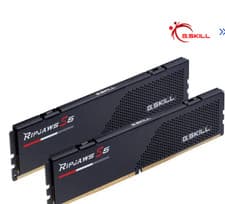
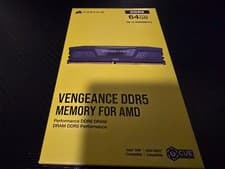
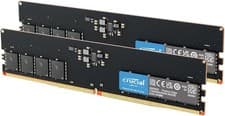
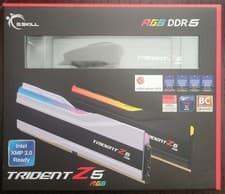
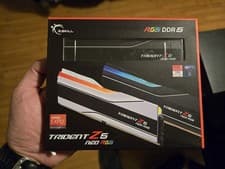
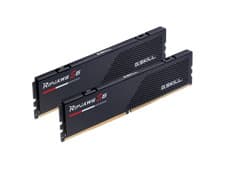
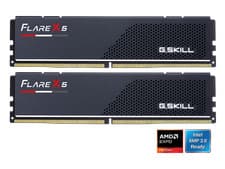
Value beats extreme frequency once you are already in the 64GB tier.
A price near its lowest tracked price is a better signal than list price alone.
On this page (8 sections)
If you want a 64GB kit, the real question is not whether 64GB is enough; it is which kits are worth buying now instead of waiting on a better deal, and how to buy the capacity without paying for frequency you do not need.
Who 64GB is actually for
64GB earns its price in specific, identifiable workloads: 4K/6K video timelines, large photo libraries, virtual machines and container stacks, big monorepo compiles, CAD assemblies, and, increasingly in 2026, running local AI models, where a quantized mid-size LLM can want 20–40GB of memory to itself. If your task list looks like that, 64GB is not a luxury; it is the difference between working and swapping.
For everyone else the honest answer is that 32GB still covers gaming and mainstream productivity comfortably, and during a shortage the jump from 32GB to 64GB costs real money that a GPU or SSD would spend better.
2×32GB, dual-rank, and why four sticks is the wrong way to get here
Buy 64GB as two 32GB modules. Populating all four slots on a current AM5 or LGA1851 board forces the memory controller to drive twice the electrical load, and officially supported speeds fall off sharply. A four-stick kit that trains reliably at its rated profile is the exception, not the rule. Two sticks run at full speed and leave two slots free for a future 128GB.
Most 32GB modules are also dual-rank (effectively two banks the controller can interleave), which adds a small real-world throughput gain over single-rank at the same timings. A 2×32GB kit already gives the controller the rank diversity people used to buy four sticks to get.
Frequency matters least in this tier
Once you are buying 64GB, spend on capacity and stability, not speed bins. The creator workloads that need this much memory are tolerant of both bandwidth and latency differences; a 6000-class kit at a good price beats a 6400+ kit at a premium in essentially all of them. That is why the ranking below leans on proximity to each kit's lowest tracked price rather than headline megatransfers.
How the list is built
Picks are DDR5 kits of 64GB or more from tracked brands, ordered by how close today's price is to the lowest we have tracked for that kit, followed by kits whose shipping-included price is too new to have a range, cheapest per GB first. Price data is scraped from eBay and Newegg several times a day and ages out of best-price selection after 7 days without re-verification; nothing older than 14 days ever displays as current. The list is computed: no kit is placed, promoted, or reordered because of commission, per our affiliate disclosure.
Some links below are affiliate links: RamRadar may earn a commission if you buy through them, at no extra cost to you. How we make money
Current top picks
Live prices from RamRadar so this page behaves like a decision page, not a static article.
RamRadar re-ranks these picks using live pricing and current fit signals instead of leaving a static affiliate list untouched for months.
Updated from live product data on Nov 20, 2026
Market-aware ranking
We favor kits trading well versus their all-time low so this page points to buyable options, not stale listicles.
Fit before hype
Capacity, platform fit, and real-world value matter more than headline specs that rarely change your outcome.
Trust-aware offers
We bias toward known brands and cleaner retailer signals so weak or misleading listings do not dominate the recommendations.
Why these picks made the cut
Live pricing
Every recommendation is pulled from current RamRadar pricing, so this page reacts to the market instead of freezing in time.
Trust-first filtering
We prioritize known brands and cleaner live pricing signals so obvious junk and misleading offers do not dominate the shortlist.
Buy-now logic
Near-ATL positioning and current value matter more than vanity specs if the goal is to buy well today.
FAQ
Who should buy 64GB DDR5?+–
Editors, workstation users, coders with heavy local environments, and builders who want longer upgrade runway.
Is 64GB overkill for gaming?+–
For most gaming-only builds, yes. 32GB usually offers better value.
Should I consider 128GB instead?+–
Only for genuinely large workloads: heavy VM labs, scientific data, very large video projects. It usually means four DIMMs or expensive 64GB modules, both of which cost speed or money. If your work needs it you already know; if you are guessing, 64GB is the ceiling worth paying for.
Who should skip 64GB
Gaming-first builders: 32GB is the better value, and the 32GB value guide is the right page. Laptop owners: many machines are soldered or single-slot. Check upgradeability before falling for a desktop kit. And if you are speccing 64GB purely "for the future," remember that in this market futureproofing carries a premium; buy for the workload you can see from here.